

The Age of Intelligence
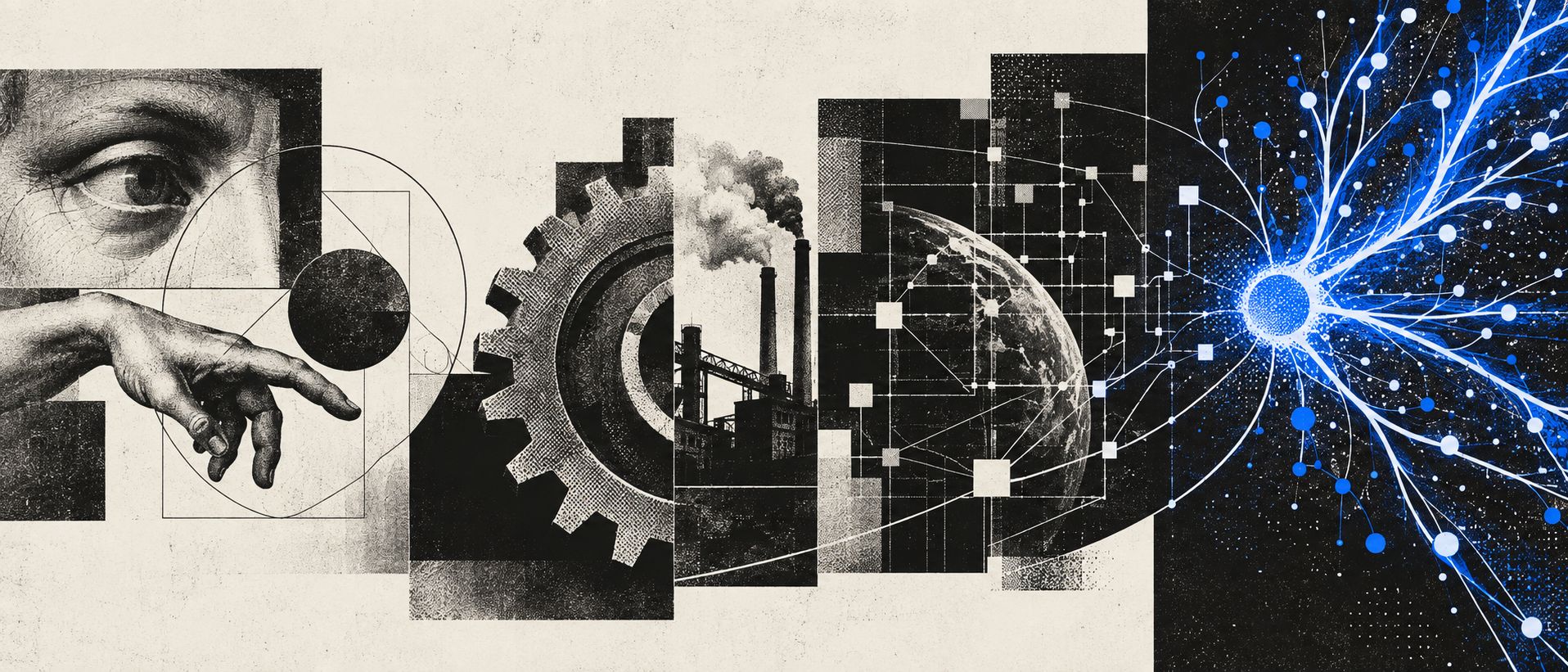
I think we will look back at this decade as the start of the Intelligence Age.
Not because AI will write our emails faster or make better pictures. Those are useful, but they are the least interesting part of the story. The bigger shift is that intelligence itself is becoming cheap, abundant and available on demand.
That has happened before, in different forms. The Renaissance made knowledge easier to recover and combine. The Industrial Revolution mechanised muscle. The internet made distribution almost free. Each of those eras produced a burst of inventions and discoveries far denser than anything before it. I believe the Intelligence Age will produce the densest burst of all.
AI now begins to mechanise parts of thought itself.
There is no historical precedent where you get all of these beneficial things (technological innovations) by starting from pessimism first. Pessimism doesn’t get you to optimistic outcomes - Kevin Scott, CTO Microsoft Source
The Renaissance made curiosity valuable
(14th to 17th century)
The Renaissance is usually remembered through art: Leonardo, Michelangelo, Raphael. But its real importance was much larger. It changed the way people looked at the world and at themselves.
Humanism placed observation, reason and individual agency at the centre of intellectual life. Art, engineering, medicine and philosophy were not separate boxes. Leonardo could paint the Mona Lisa, study the human body and sketch flying machines because curiosity was allowed to move across disciplines. Galileo moved just as freely between astronomy, physics and instrument-making.
The printing press helped ideas travel further and survive longer. A method, diagram or argument could reach thousands of people, be challenged, improved and combined with something else. By 1500, barely fifty years after Gutenberg, Europe had produced some 30,000 printed editions, in a world that had previously copied books one at a time by hand.
And the inventions kept coming. The microscope in the 1590s. The telescope in 1608. The pendulum clock in 1656. Each new instrument opened a field that had not existed before it.
The era also produced a new type of builder: the individual who believed the world was understandable and therefore changeable. That mindset prepared the ground for the Scientific Revolution and the research institutions we take for granted today. Newton was the capstone of that shift: optics, gravity and calculus alongside deep work in alchemy and theology, a bridge from Renaissance curiosity into the Scientific Revolution. Polymaths recur whenever the cost of crossing disciplines falls.
The Industrial Revolution gave ideas muscle
(1760s to early 1900s)
If the Renaissance changed how we thought, the Industrial Revolution changed how we made things.
Steam power, mechanised manufacturing, railways and new production methods converted ideas into physical scale. The spinning jenny arrived in 1764, Watt’s improved steam engine in 1776, and the power loom, the locomotive and the telegraph by 1837. A second wave followed: the telephone in 1876, the light bulb in 1879, the automobile in 1886. According to Britannica’s history of the Industrial Revolution, the shift from agrarian, handicraft economies to machine manufacturing transformed production, transport and everyday life. Alexander Graham Bell crossed telephony, hearing science and aeronautics. Thomas Edison moved from light and power to recorded sound and film, then built the laboratory model that made invention repeatable.
You can see the burst in the numbers. English patent records show annual grants rising from an average of about 20 a year in the 1760s to over 450 a year by the 1840s. Invention had become a habit, then an industry.
The second-order effects were even bigger. Mass production made products cheaper, transport created national markets and cities expanded around factories. Time itself became standardised because railways and factories needed coordination.
But this progress came with a huge bill. Dangerous factories, child labour, pollution, overcrowded cities and brutal working conditions were not side effects at the edge of the system. They were built into its early economics.
That is one of the most important lessons from every technological era: progress arrives before society has worked out how to distribute it fairly.
The internet made distribution almost free
(1990s to today)
The internet was another such break. It did not create information, commerce or communities. It removed the cost and friction of distributing them.
A small company could reach customers around the world. A creator could publish without owning a printing press. A developer in Bengaluru could build software used in San Francisco. Smartphones put the network in everyone’s pocket.
The density numbers here are almost silly. The world’s first website went live in 1991; today there are roughly 1.88 billion websites. America’s patent office took 121 years, from 1790 to 1911, to grant its first million patents. Its most recent million took three years.
New businesses appeared because distribution was no longer the advantage it used to be. Amazon reworked how commerce could function. Social networks made every user both a consumer and a distributor. Steve Jobs recombined computing, design, music and phones into products that made the network feel personal. Jeff Bezos turned distribution into logistics and, eventually, cloud infrastructure.
Every era abstracts us one more layer
Underneath all of this is a deeper pattern. Over billions of years of evolution, every species has taken the path of least resistance. Humans are no different. Whenever we found a way to hand menial, back-breaking work to something else, we took it.
The steam pump replaced the people and horses draining mines. The power loom took over the weaver’s shuttle. The tractor replaced the plough. The washing machine replaced the washboard. Then the abstraction moved indoors: calculators took over arithmetic, and accounting software took over the books of accounts. For centuries, “computer” was a person’s job title. Then the machine took the name.
Each layer of abstraction freed time and energy for the layer above. And it was never optional. The companies that decided not to adopt mechanisation and industrialisation did not preserve jobs. They perished, and the jobs went with them.
AI is the next step on that staircase. This time it abstracts not our muscles, but parts of our minds.
AI makes intelligence abundant
The printing press scaled knowledge. Machines scaled labour. The internet scaled distribution. AI scales parts of cognition: writing, coding, pattern recognition, analysis, simulation and, increasingly, reasoning. This is where it starts to feel different from every technology that came before it.
The cost curve is already moving at a ridiculous pace. The Stanford AI Index 2025 found that the cost of using a model performing at roughly GPT-3.5 level fell more than 280 times between November 2022 and October 2024. Capabilities that were expensive and rare are becoming cheap and ordinary.
Models are also getting remarkably good at rote, repetitive work. A model can now execute several hundred tool calls in a row with high accuracy while holding the full context of the task, work that is increasingly trivial for it. Humans doing the same work get bored, and bored humans get inaccurate. We once employed people to press buttons in elevators and to direct traffic at junctions. Automatic elevators and traffic lights took those jobs, and nobody wants them back. Whole occupations have become obsolete in our lifetime without us noticing. Today, making a human stand in a lift pressing buttons all day feels almost inhuman.
In his July 2025 memo on personal superintelligence, Mark Zuckerberg drew a useful line between AI that empowers an individual and AI that simply automates valuable work to replace them. His vision is AI that gives people more agency to create, learn, build and pursue their own goals. That distinction matters, because intelligence can become abundant while power remains concentrated. The promise is not a machine that does everything for us. It is a machine that helps far more people do what was previously beyond their time, training or means.
AI is also helping people become more creative: to think beyond the limits we have assumed for ourselves. The laws of physics are, I believe, the only real limits. The limits in our minds are not real. A tool that proposes ten novel approaches before breakfast changes what a person dares to attempt. That is why I believe the Intelligence Age will usher in the highest density of inventions and discoveries humanity has ever seen.
We can already see the outline in science. AlphaFold made more than 200 million predicted protein structures openly available, covering almost every catalogued protein known to science. Work that once required years of specialist effort can now begin with a powerful prediction. Demis Hassabis’s path from games and neuroscience to AI and protein folding is almost a case study in disciplines collapsing into one another.
Imagine the same acceleration across drug discovery, climate modelling, materials science and energy. If AI helps a researcher test ten thousand hypotheses instead of ten, the pace of discovery changes anyway. That is the Renaissance pattern, and the Industrial Revolution pattern. The difference is that these machines extend parts of our minds, not only our hands. Fei-Fei Li’s work across computer vision, neuroscience and human-centred AI shows the same pattern from another direction.
What this era could usher in
First, far more people will be able to build. Software creation is already moving from knowing syntax to describing intent, which changes the starting line. More builders making more attempts is how the density of invention rises.
Second, research will become more iterative. AI can read the literature, find patterns across huge datasets, propose candidates and help design experiments. The scarce input shifts from searching what is known to asking better questions.
Third, small teams will gain extraordinary operating leverage. For emerging markets, including India, this is especially powerful. Talent has always been abundant here; access to specialist capability has not. AI starts to close that gap.
The result should be more entrepreneurship, faster experimentation and many more strange, ambitious projects that would never have cleared the old cost threshold.
Every era cuts both ways
Every technology can be used well or badly. A knife can cook a memorable meal, or it can kill someone. Open source software can teach millions of people to build, or it can power the tools that hack them. The tool does not choose. We do.
So the real work of every era is not inventing the technology. It is making sure the good overpowers the bad. Technology does not arrive with a moral direction. It magnifies the incentives around it.
The uncomfortable side of abundance
There is, obviously, a darker version of this future. But the jobs part of the anxiety is older than this technology.
Every era disrupted work and then created jobs nobody had imagined. The power loom destroyed the hand-loom weaver’s livelihood, and created mill, railway and machine-repair jobs that had never existed. In the US, 40 percent of employment was in agriculture at the start of the twentieth century; today it is under 2 percent, and the country did not run out of work. Lamplighters, switchboard operators and video-rental clerks disappeared; software developers, data scientists and wind-turbine technicians arrived. In a few decades, I suspect we will look at some of today’s jobs the way we now look at elevator operators. Not because we think humans are not good at them, but because we believe humans should be doing better work: being high agency, creating, thinking, expanding our assumed limits. Humans are the ultimate intelligent species. Our work should reflect that.
The transition pain is still real. The International Labour Organization estimates that one in four workers globally is in an occupation with some exposure to generative AI, though it expects transformation more than outright replacement for most jobs. That may be true in aggregate and still be deeply painful for individuals. Reskilling sounds clean in a presentation; it is much harder with a mortgage, a family and twenty years of experience in a role being automated.
Power could also become more concentrated. Training frontier models requires capital, chips, data and energy at a scale few can access; the Stanford AI Index found nearly 90% of notable AI models in 2024 came from industry. If intelligence becomes critical infrastructure, who owns it matters.
When text, audio, images and video can be created at negligible cost, proof becomes expensive. Trust and reputation will matter more, not less.
And AI has a physical footprint. The International Energy Agency expects global electricity use by data centres to more than double by 2030, with AI as the biggest driver of that growth. Intelligence may feel like software, but it runs on land, chips, water and power.
Finally, there is a subtler risk: intellectual laziness. If AI gives us an answer before we have struggled with the question, we may confuse speed with understanding. Tools that make us more capable can also make us more dependent.
The real level playing field
Every era levelled the playing field in one way and widened the wealth gap in another. Printing made books cheap and publishers powerful. The internet gave everyone a storefront and made a handful of platforms into empires. AI will do both at once.
The dividing line in this era, I think, will be agency. High agency is hard to teach, and people without it become dependent on systems they do not control. Dependence is how disparity compounds. Market forces, psychological forces and plain luck all play their part. Very little in life is in any one person’s control.
But one thing is distributed perfectly equally: time. Everyone gets the same 24 hours in a day, seven days in a week, 365 days in a year. That is the level playing field. What has changed is what you can do with those hours. AI makes the tools of thinking and building accessible to everyone, at almost zero cost, so everyone has a shot at the big prize. The people who become AI-native, who learn to think and build with these tools rather than compete against them, will be the ones who break out of the wealth disparities earlier eras left behind.
We are living through the messy middle
Every transformative era looks obvious in retrospect and chaotic while it is happening.
People living through the Renaissance did not wake up and announce a new age. Factory workers in Manchester were not thinking about a future chapter called the Industrial Revolution. They were dealing with immediate changes to work, family and place.
We are in that same messy middle now. The toys, frauds and bad products are arriving alongside the genuinely important work. Regulators are trying to write rules for systems that change every few months. Most companies are adding AI to old workflows when the real opportunity is to redesign the workflow entirely.
I am optimistic, not because the downsides will solve themselves, but because abundance creates more builders, and builders push technology into places its inventors did not imagine.
The most interesting companies of this era will ask what becomes possible when intelligence is no longer the limiting factor.
Just as the printing press produced more than cheaper books, and the steam engine produced more than faster manufacturing, AI will produce more than cheaper knowledge work.
It will change who gets to invent.
And if history is any guide, that will change almost everything else.
This is probably the best time in history to be living, building and investing.